Anika Nilles: Putting in The Work and Finding the Feeling of Rush
By David Frangioni, Modern Drummer, September 2026, transcribed by pwrwindows
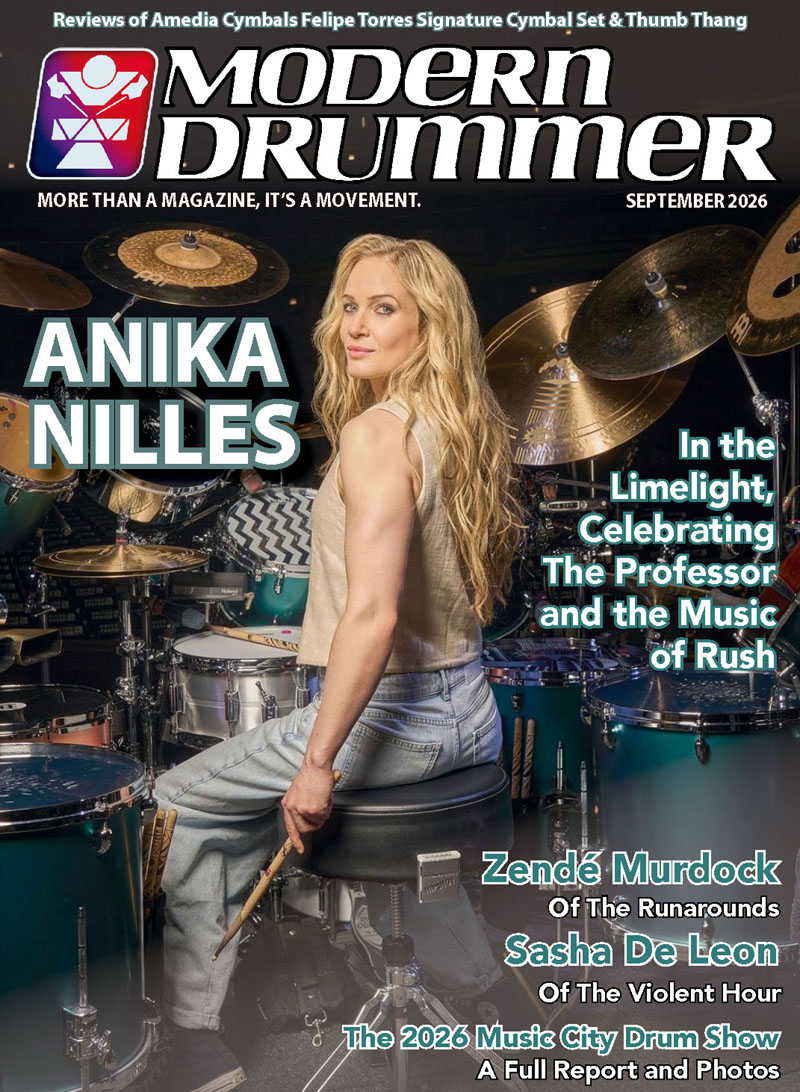
Anika Nilles was first on the cover of Modern Drummer in June of 2017. At that point in her career, she was a popular YouTube drummer with a new record and a newly formed band. Her drumming was turning heads, and people were taking notice. Her musical future was bright, and the musical sky was the limit. Since then, A LOT has happened. Her band Nevell started touring internationally, and the legendary Jeff Beck saw her videos on YouTube and hired her to tour with his band. After Beck's death, and the worldwide COVID pandemic, Anika (like everyone else) was a little lost. The loss of Jeff Beck affected her deeply, and she struggled to regain her musical direction. After some time of reflection and introspection with friends, family, and mentors; her band started to tour and record again. She had come through the fog of life and her drumming and musicality just kept getting better. But no one knew what was right around the corner.
With the offer to join Rush, Geddy Lee and Alex Lifeson pointed the spotlight on the absent and most admired drum throne ever. The attention from drummers and Rush fans could not have been bigger, and the spotlight could not have been brighter. But Rush's iconic music and Neil Peart's well sculpted drum parts loomed in the distance as Nilles accepted the challenge and their offer to tour. In 2025 and 2026 Anika Nilles became one of the biggest stories in the drumming and music world. There were many interviews and lots of attention. But she kept her head down, did the work, and is now playing drums on the most anticipated tour of recent history.
As Anika describes here, there were a few bumps in the road with the Jeff Beck gig, and the Rush gig, but her musical and drum training from Claus Hessler had prepared her. As her work ethic developed, her career continued to blossom. Modern Drummer's publisher David Frangioni, a lifelong Rush fan and Neil Peart admirer, was thrilled to see the band playing the entirety of Rush's Moving Pictures in Chicago; and talk to Anika about her recent journey, the Jeff Beck gig, Rush, learning the Rush music, her Rush kit, and everything else. There couldn't be more to talk about in her second cover feature, and we are so excited to welcome her back to the cover of Modern Drummer.
MD: Welcome, Anika.
AN: It's very nice to meet you.
MD: You sounded amazing last night, but let's start by getting your name on record correctly. How do we say your name correctly?
AN: Actually, the German pronunciation is Nil-es, but so many people get it wrong, and it comes out as something else. So I prefer the English version of Niles (rhymes with smiles.) That is how I'm saying it myself, so feel free. For me, that's correct. And for Geddy Lee, it's apparently correct, because he says it that way on stage.
MD: All right, everyone, there you have it on record. You were on the cover in 2017, and you were a YouTube phenomenon at that time. That was what the story was about, and we talked about your history and how you had gotten to that point. Let's pick up the story from June of 2017. What happened between then and getting the gig with Jeff Beck?
AN: A lot. I recorded three more albums. My first album was in 2017, it is called Pikalar, now I have three more albums out, I also started my own band called Nevell, and we played a lot of shows between 2017 and getting the gig with Jeff Beck.
MD: Were you playing in Europe or worldwide?
AN: Mostly Europe, but also Australia. During that time I did a lot, a lot of drum clinics, traveled around the world doing master classes, a lot of drum clinics, and drum festival performances. That was what I did for a long time. Even before Jeff, I was focusing more on the band and trying to bring the band on stage to play more, and that worked out.
MD: Nevell was and is a passion project.
AN: Yes, absolutely.
MD: When you approach your drum parts, what is your approach to the song and to the drums?
AN: That has changed over time, when we started off, we kept everything really close to the recorded versions, but that felt really limiting on stage. Nevell has a lot of complex music, and it can be tiring for the brain to just play complex stuff all the time, for the audience and the band as well. We thought we had to give the audience and ourselves kind of a mental pause from all this complex stuff during a concert. That inspired us to open it up a little bit and include songs where we jam more and go more freestyle. To free things up a little more, we wrote a couple of less complex songs that we just play live, so we could involve the audience more. On stage with Nevell, I play less complex, I have a percussion player in the band, and he can play a lot of the little details, so I can just keep time more and solo when I feel like soloing. That way I don't have to play all the ghost notes and all the little details all the time. He is freeing me up, so I don't have to rely too much on the original drum parts.
Nevell has a lot of complex music, and it can be tiring for the brain to just play complex stuff all the time, for the audience and the band as well. We thought we had to give the audience and ourselves kind of a mental pause from all this complex stuff during a concert.
MD: How do you compose? Does it start with the melodies, or the drum parts?
AN: Sometimes I start with harmonies or melodies. I write mostly on the keyboard, and then I add my drums along to the melodies. Other times I start off with drum ideas, and then I add the music around that. It's always different. Sometimes it's way more rhythmic, and sometimes it's way more structured, because I build up the parts that way. I like to compose both ways.
MD: How did the song "Pikalar" come about?
AN: That started off with harmonies and melodies, then I added drums.
MD: As your band was working, how did Jeff Beck come into your life? How did that gig come about?
AN: Actually, Jeff saw my YouTube videos. At the time, he was really a YouTuber.
MD: Jeff Beck saw your videos?
AN: He told me he'd hang out in his living room, and he enjoyed watching a lot of YouTube music videos from the old days, and of bands that he loved. Then as he was preparing for a European tour, during the post-COVID time when everyone had to have their shots, he was looking for a European drummer for the Europe gigs. So he remembered that clips of me were popping up when he was watching YouTube. And so he found my videos and reached out. That's basically how it happened.
I love to talk to friends and family a lot. I cannot keep stuff inside me. I have to talk myself through difficulties. I have good friends around me. And that brought me back to a more creative feeling.
MD: And did you get an email from Jeff Beck or his manager?
Anika: Yeah, from his manager.
MD: You must get a lot of correspondence from many people around the world. How did you know that this was not just some crazy person saying, "I'm Jeff Beck and I'd like you to drum with me?"
AN: Exactly! You get so many weird messages these days, so you don't really know what's the truth. So I looked the person's name up and he was really Jeff's manager. So I got back to him. I flew to London to hang out with Jeff for three days just to see if it would work. We entered the studio and just jammed. Actually on day one, we just got a little drunk. We were just hanging in his living room drinking wine and talking. We got to know each other. On the second day we just jammed. On the third day, we had lunch together with his wife. It was really, really chill. Then I flew back home and it was all set.
MD: So at that point, both of you knew that this would work. This is going to be great.
AN: Yeah, it felt really good.
MD: Did he have you prepare anything before you got there?
AN: Not really. I asked them if I should prepare some songs. But they said no and just suggested that I might want to listen to a few things. But when we jammed, we didn't even touch the songs that I had listened to. We really just jammed.
MD: What did you listen to?
AN: A couple of songs, "Blue Wind," and the Blow by Blow record. But we didn't touch them, it was just jamming and getting to know each other musically and personally. Once everything was decided, we had a tour coming up. So we had to get into rehearsals. We (the band) received a huge list of almost 40 songs to prepare. Then, we had rehearsals where they decided on production and Jeff decided what songs would be in the final set list. So we removed 20 songs and started the final rehearsals.
MD: Was it the same set every night?
AN: It was pretty much the same set every night. We had Johnny Depp in the band as well, so he would come out in the second half of the show. The first half was Jeff jamming out, and the second half was songs with Johnny.
I received a list of six songs to prepare and learn. I think it was "Limelight," "Tom Sawyer," "Caravan," "Subdivisions," "The Spirit of Radio," and "YYZ." And I think we did "Red Barchetta" in the second rehearsal.
MD: The spotlight just keeps getting bigger and bigger. But Johnny's a great musician, a great guy, and a great personality. Joe Perry (from Aerosmith) is a friend of mine and he's in the Hollywood Vampires with Johnny. Joe said to me, "When we bring Johnny in, it's musically, very different. But there's also a celebrity factor that's really extreme. It's one thing to be a rock star, but it's a different thing to be a movie star. And when the two collide... you have very different crowds.
AN: Yeah. I didn't know Jeff's crowd before that, because that was my first tour. But everyone said the crowd got younger and there were lot of females in the room. But it was a lot of fun. Johnny is a character, and those two (Jeff and Johnny) were like teenage kids, they had so much fun both on stage and off.
MD: After that did you go back into Nevell? What happened between Jeff Beck and Rush?
AN: No, Jeff passed right after the tour finished, and that was a huge shock for all of us. For me, I didn't know Jeff for a long time, but when you're on the road and have such a great time together, you get really close, and it's intense. After he died, it took me almost a half year to really do something. I almost disappeared because it was really tough to process what had just happened and how it ended. I was not in a creative mood at all. I couldn't really practice, I couldn't write, I wasn't prepared to be on stage. I just had to deal with that for a while. So it took me at least half a year. Because of COVID and then playing with Jeff, it was almost two years since what I was doing before Jeff. Then it took me another six to eight months until I got job offers and made it back on stage. With a band, you have to book shows in advance. So in total, it took one and a half years to get back to a (kind of) a normal routine with playing shows and practice. It was a difficult time for everyone. But a year passed before I had finally gotten back in a normal flow, and then Rush called.
I listened to those songs a lot. I was thinking about how I could approach and learn them in a really effective way. Because three weeks to nail that stuff is not much time. I started by trying to transcribe the drum parts, but then I decided that wouldn't work.
MD: That's quite a journey. That's a lot of years of riding the wave with those extreme ups and downs. What did you do to cope with it? Everybody has a different approach to how they get their inner self to regroup, process, and move forward. What was your approach?
AN: I love to talk to friends and family a lot. I cannot keep stuff inside me. I have to talk myself through difficulties. I have good friends around me. And that brought me back to a more creative feeling. I was jamming with a couple of my friends, and I did some casual shows back home, not even in Germany, just local. And that brought me back.
MD: That was your therapy, and it worked.
AN: Yeah.
MD: Now we've gotten to the call from Rush, and the story has already been told. So for anybody who isn't familiar with the story, Rick Beato did a great interview with you, and he covered all of that. What did you do to prepare for your first time playing with Alex and Geddy? And how did it evolve from there?
AN: First, we had a chat on Zoom, I was still on tour with my band. I had one more week to go before I could actually sit on my drums and start to figure out the songs.
MD: How much time was there between that chat, when you got back, and the day of playing with the guys?
AN: I think it was three weeks total. I received a list of six songs to prepare and learn. I think it was "Limelight," "Tom Sawyer," "Caravan," "Subdivisions," "The Spirit of Radio," and "YYZ." And I think we did "Red Barchetta" in the second rehearsal.
MD: Those are six (actually seven) iconic, really challenging songs. So you had three weeks to really get six songs down. When you really got into learning those six songs, were you just listening to them or did you stem them out? Because nowadays with the tools available, you can isolate the drums, and you can really hear what was being played.
AN: Within that last week of touring, I listened to those songs a lot. I was thinking about how I could approach and learn them in a really effective way. Because three weeks to nail that stuff is not much time. I started by trying to transcribe the drum parts, but then I decided that wouldn't work. I was spending too much time with that. So then I thought that I should make some short cheat notes. But even that was really difficult. The more I listened, the more I thought, 'What the hell are they doing?' Not for every song, but specifically for "The Spirit of Radio."
MD: There's so many tempo and time changes in that song.
AN: Yes, tempo changes, time changes... In a way, you can't tap your foot along to that. The band was really flowing in that tune. That specific tune was one of the hardest to prepare. You can sit there and practice along to the record and you'll capture how it was recorded. But that doesn't necessarily mean it will be exactly the same live, because it has a very human feeling, it's not the same every time you play it. Sometimes it's slower, sometimes a bit faster. And I wasn't sure about those elements. I didn't know how to prepare that and nail those parts. So with a lot of that stuff, I was in touch with Scully, the bass tech.
MD: So Scully could give you some insight? When you're listening to "The Spirit of Radio" and Neil plays the glockenspiel part, what were you thinking? Did you wonder if they expected you to do that, which would be a natural thing.
AN: I knew I had to do that, so I was asking people around me if they had a glockenspiel. One person actually asked me, "What? Are you preparing for Rush?" And I had to say, 'No.' But Scully told me that they sampled Neil's percussion sounds. Because Neil was not playing a lot of percussion because he had a Mallet Kat later on. So they sampled the glockenspiel stuff, and I figured that I could play those parts on the Roland SPD-SX pads. So I was good with that.
MD: You planned to bring your Roland pads loaded with all of the sounds?
AN: At the beginning, I just took some generic sounds to build my muscle memory until they loaded the actual sounds in.
The more I listened, the more I thought, 'What the hell are they doing?' Not for every song, but specifically for "The Spirit of Radio."
MD: But you're coordinating all of that with Scully. That's a lot of back and forth. When you got to the audition, did those sounds come off the way that you envisioned.
AN: I was trying to build the muscle memory. But if something is different and you're not familiar with positioning of specific sounds on the set, it destroys your muscle memory. And it can destroy the moment.
MD: You had Scully and you had the foresight to have those back-and-forth conversations. A lot of times with famous bands, there has to be a "go-between person." Because the principals of the band are not going to get in the weeds of all of that back and forth. But somebody has to coordinate all that stuff.
AN: Scully was super helpful with that. But even for him, the fact that the guys didn't play for the last ten years created some problems. There were things that he didn't remember, and technology things that he didn't know. He did not know all the answers. He was just giving me his thoughts and the expectations of parts and how they should come out.
MD: But he did do the prep to get the SPD-SX and the sounds ready.
AN: Yes, Sully and the keyboard tech did that.
MD: So you knew when you were going in that all the percussion sounds were already designed — basically.
AN: Yeah.
MD: So you didn't have to think about that part too much. But you had to learn all of it. So what did you do to get inside of Neil's parts and prepare for those six songs? Were you stemming them out?
I was asking people around me if they had a glockenspiel. One person actually asked me, "What? Are you preparing for Rush?" And I had to say, 'No.'
AN: Yes. I did stems from the stereo recorded versions. I stemmed them out and put the drums on mute after I learned the specifics. I chopped them up, step by step because learning them by charting them out didn't work. So I had to listen, memorize, and play. And then I switched the drum stem on and off. I played without it, I played with it, and I played just with the drums and the bass. I feel that if you're always locked in with the bass and know what the bass is doing, that's all you really need to know. You can even go through a song without vocals, which is often the guideline for many things.
MD: Especially with Rush and Geddy and Neil... That was an integral part of their sound, how locked it was. So what's the first song you ever played with Geddy and Alex?
AN: I think it was "Subdivisions."
MD: You started with "Subdivisions," and were you comfortable with that?
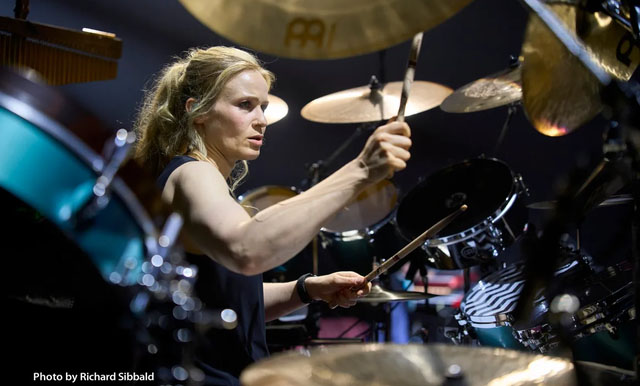
AN: Yeah, that was definitely a song where I felt comfortable. I tried to capture the parts at that point. The first rehearsal was more focused on learning the parts. I had to learn the orchestration of everything. But there was a problem, I was not focused too much on the feeling. I had actually never been required to capture the feeling of a specific drummer. The parts? Yes. The orchestration? Yes. But, as we got done the first rehearsal, the aspect of feeling came up. Like how to feel a part.
MD: You asked them.
AN: No, they asked me. Especially for "Tom Sawyer," actually, it was less for the other songs. It was mostly on "Tom Sawyer" where we dove into that deep hole of, how should that part feel? And when we played it, Geddy said that it wasn't sitting where it had to sit. It didn't feel comfortable when I was playing it. His bass was not locked in. His voice, for certain rhythmic parts wasn't locked in. My snare was not falling in a place where he was used to hearing it fall into place.
So we talked about that stuff a lot. A lot of it was Neil's feeling, and how he played a groove. Actually, a lot of it was the opposite of how I would naturally play. My feeling is more laid back. His feeling was more on top of the beat, really snappy and really energetic. I had to learn to play more with his feel in specific parts of songs. Not every time, not the whole show, but specific parts of specific songs needed to have his feeling in them, so that the song sounded how it was supposed to sound. The band needed to sound how they sound, and Geddy and Alex needed to feel comfortable.
MD: You had learned the six songs, and you got into rehearsal and that was the first feedback? They were giving you one of their first pieces of feedback on "Tom Sawyer." You'd already spent all that time listening to Neil's playing, but then you're hearing Geddy and Alex's perspective of how you heard Neil's playing and how they're hearing it. Did they give you time to go and work that out?
AN: Let's back up, we didn't start off with "Tom Sawyer." We did that on the second or third day.
MD: And, as you know, Alex told Classic Rock that on day four he and Geddy were not sure it was working. And then on day five it clicked.
AN: Yeah, there were also moments on day four when I thought, 'I'm not sure if I'm up to this task.' Because we talked about the feeling with "Tom Sawyer" on day four and I had to learn about Neil's feeling really quick. During that one day I had to learn what they required from me feeling-wise. And I had to learn and understand what Neil's feeling really was to them. I went back to the hotel after that session, and I just went through all the talks we had, and I tried to figure and really internalize what they told me. I sat in the hotel room, I listened back, and I played the parts on a pillow.
MD: No practice kit?
AN: Nope, pillows. I also had a talk with my producer; he's a guitarist and a big Rush guy. He listened to Rush a lot when he was younger. He gave me the confidence. He nailed it, he said, "You just have to listen to the songs a couple of more times." And the next day the feeling was there. I think I got it while I was sleeping that night. Thinking about everything definitely helped. That was day five that they were referring to.
...if something is different and you're not familiar with positioning of specific sounds on the set, it destroys your muscle memory. And it can destroy the moment.
MD: I've seen Rush perform many times; I am a total drum nerd, Rush head, and Neil fan. I saw every tour at least once starting with Moving Pictures. From my point of reference, and with that perspective, there's no other band like Rush, and no other fan base like Rush fans. When I would go to those shows as a teenager, the reaction was the same. Today it's maybe even more maniacal as when I would see the shows when I was 16 years old. The fan base has gotten even more passionate over the years. But what I'm referring to is the fan response and the interactive emotion not only for the songs, but for the actual drum parts. It's one thing to go see Phil Collins and 20,000 people air drum the big fill to "In the Air Tonight." It's another thing when they're air drumming to almost every song and every fill, especially the really big ones.
Modern Drummer correspondent Dennis Wolfe was at the LA show, which was your first public performance with the band. He sent me a video afterward and we were both in tears. I know that sounds a bit dramatic, but it really isn't when you combine our love for Neil, our love for this music, and our wanting to see you succeed. Then to see it all work and see the music sound great was amazing. Because when your playing wins, the music wins. And if the music wins, the fans win. So just seeing it happen was very profound. He sent me this video, and the video was as much of the audience as it was of the show. And during "Tom Sawyer" everybody was on their toes, and not exhaling, until you finished the iconic fill and the big kicks. Then (I think) you even almost broke a smile for a second and everybody just let out a huge roar. It was like scoring the winning run in game seven of the World Series. How did it feel up on the stage? I've honestly never seen anything like that.
AN: I felt really good to bring that one out, and get it off the table, I think that was the most important song for the fans and also for me. It was important to nail that, and it was such a relief. About five seconds before that fill I was thinking, 'OK, let's go!' Maybe that was the thought of the fans too.
MD: Fast forward, you are now several shows into the tour, and we have this interview after you played three nights in Chicago. Last night was the first time I've been able to see you on this tour and you're playing was absolutely phenomenal. I know I speak for all the fans there because I was speaking to some people around me at the show. I was getting a sense of the temperament and the vibe that the whole point of this tour (and you're playing) is that it's a tribute to Neil, because he created the music already, and that's what's being played. There's already a clear imprint of this is what it is. And as much of a creative musician, an artist, and a great drummer as you are, your role in this is to pay tribute and not take creative liberties, and I think that is what is so brilliant about your approach. It was fresh, it had this youth and power that almost breathed new life into the songs, and you nailed all the parts. Because if you didn't, you'd have 20,000 people air drumming the wrong parts. And I'm just so happy for you, I'm happy for the band, and I'm happy for the fans. No one has seen Rush in such a long time, I forgot how many signature parts there are. There were a lot of chances for you to not get it right, but you nailed it!
AN: I have said in the past that I know there are so many ways to fk this up, every song has so many parts, it would be very easy to fuck something up.
MD: How many fan bases know every note of every song? But I love your approach to it. You have this silent passion that's exuberant. Your performance has got all this youth and liveliness in it. But it pays tribute with great discipline, and that comes through on all the songs. You're able to stay cool and be the drummer that the fans want you to be. Everybody wants you to succeed, and I love that. I've never seen that at a concert, but everybody is talking about it and it's beautiful to see. And it's beautiful for Rush. All of that learning and getting into the songs is paying off. But what's interesting is before Rush or Jeff Beck called, you weren't a "Rush head" or a "Jeff Beck head" either.
AN: Exactly, of course I knew who Neil Peart was. If you are a drummer, you know who Neil was, you know about his drumming, and you know that he was very compositional. I knew a couple of songs, but not in the way like I know "YYZ" now. I knew "Tom Sawyer" but not in the way that I was able to play along with it. There's a difference between when I listen and enjoy and when I have to learn something. When I do listen and enjoy, I don't analyze too much. But when I have to learn something, I analyze the drum parts because I need to know what's happening. So I didn't know much about Rush. I grew up with the generation of bands after Rush, bands like Dream Theater, Foo Fighters, Chili Peppers, all the bands which are influenced by Rush. I personally listened a lot to Toto and Jeff Porcaro, he was my biggest influence.
MD: Now that you've learned all the songs, what was the hardest one to learn?
AN: I would say "Xanadu." We played that at the second rehearsal when we already knew each other a little. But that song is so different from all the other songs I had on my list because it was on and off playing, and it was on and off time signatures.
MD: That's such a hard song to play, and now you have to play it exactly as Neil played it.
AN: Exactly. There are a lot of time signatures in there. As I listened to it, I didn't know how they played it live, and what was the feeling. I didn't know what was prepared, what had been discussed before, what was improvisational on stage, and especially in the intro of the song. I wasn't sure if it was all counted out and well planned, or if Neil came in with that wood block part by feeling. I didn't know if he was playing the same part every time. So I listened to a couple of live recordings, and it was kind of different, but also very similar, so it was hard to tell.
MD: How did you settle on how you were going to play it?
AN: At that point I could reach out to the guys directly and ask, so I was just texting Geddy all the time, asking him, 'What is this?'
MD: That is a game changer and obviously they were very open and collaborative.
AN: Absolutely, so it was like we were working on it together.
MD: How many songs in total did you have to learn?
AN: 46 or 47, considering "2112" as seven songs.
MD: Every night is some variation of those 47 songs?
AN: We have a stable number of songs in the set, but there are many songs that change. The stable ones are the most iconic songs. Every night we play, "I'm Sorry," [sic] "Subdivisions," and "Xanadu." But songs like "New World Man," "Distant Early Warning," will come and go. Songs that are on and off (for example,) are "Caravan," "Headlong Flight," and "Analog Kid."
A lot of it was Neil's feeling, and how he played a groove. Actually, a lot of it was the opposite of how I would naturally play. My feeling is more laid back. His feeling was more on top of the beat, really snappy and really energetic. I had to learn to play more with his feel in specific parts of songs.
MD: They all seem like a blast to play, and you look like you're having a blast playing them, but do you have a favorite?
AN: Yeah, I love when we play the whole Moving Pictures record.
MD: You did that last night.
AN: I was so happy.
MD: That's the first tour I saw Neil on, and that's really when I discovered the band. Our good friend Charlie Benante, (a fellow Rush head,) was telling me that he changed his travel plans to be there last night because he wanted to see Moving Pictures. Somehow, he knew that that was going to happen last night. What an album!
AN: Yeah.
MD: There's a Moving Pictures Super Deluxe Box Set of that album that came out a few years ago, and it has all these versions and outtakes, it's just it's a phenomenal deep dive into that album. But there's no deeper dive than learning the songs, learning the drum parts, and performing them with Rush.
So let's go into what prepared you for this adventure, the drum side of Anika Nilles. You studied with Claus Hessler. He was a student of a teacher of mine, Dom Famularo, who was also a great educator. What changed and evolved through studying with Claus? What did he teach you?
AN: A lot. He actually changed the whole game for me, especially when it comes to technique. I didn't have much technique before I started studying with Claus. So he was really giving me the whole "Claus Hessler approach."
MD: Which is the study of movement?
AN: Yes. The study of movement and technique, exactly. Moeller technique, and (of course) some rudimental stuff. For some reason I had never really taken a deep dive down that rabbit hole. Definitely not in the way that he does it. When I think back, I started taking lessons with Claus when I was 19. That was way before I even studied music. I practiced so much of his techniques because they are a game changer for me.
MD: Obviously, your hard work is the reason you are where you are today. But doing the hard work with those specific tools could be credited with why you've been able to succeed so well at these gigs. Jeff Beck and Rush's music is not only incredibly hard to play musically and drum wise, but they're incredibly hard to learn in a small amount of time. In order to play and improvise with Jeff Beck you have to already have things down before you get into that situation. And that takes a lot of studying, practicing, and learning the right things. If you look back, was Claus the game changer?
He has a unique approach; it's a really human approach. He never says something doesn't sound good or you should do this or that. He never says things like that. He always approaches things in a way that is motivational and not depressing.
AN: Yeah, he definitely was. After I had developed the technique, I was able to play things I wasn't able to play before, and I could do it with proper technique. That's definitely a game changer. The speed, the timing, the precision, the strength, and even the looseness of things — Not being tight all the time with your muscles, keeping relaxed while playing, that changes your sound too. That's a big game changer.
MD: On this gig, for instance, you're playing two sets, and it's like 150 miles an hour the whole night. With that, is your endurance an issue? With what Claus teaches about movement, does the lack of tension mean that you can play longer and not have injuries.
AN: Yes, exactly. That's a big part of it too. Keeping relaxed, don't injure yourself by getting tight or doing stupid movements with your muscles or your bones.
MD: How long into studying with Claus did he introduce you to the Moeller technique?
AN: Immediately.
MD: Oh, really? Right off the bat? Wow.
AN: I started using my wrists more, and I definitely started involving my fingers and using more rebound. We dove right into Moeller.
MD: It's fascinating, as drummers, when we're first exposed to Moeller, it's like somebody unlocked a door that opens possibilities that you never imagined.
AN: Absolutely. It unlocks so much. I can remember that I was not a big practicer at that time and I was in a group class with Claus at a camp. It was in addition to my regular studies with him, and at the end of the camp everyone had to play in front of everyone.
MD: Oh, that's scary.
AN: That's really scary because you don't want to mess things up in front of other drummers. I knew I had to get my shit together and practice. That really brought me to a point where I realized after two weeks practicing, I was able to do things I never thought I was able to do because I simply practiced. It really clicked for me in a way that I knew if I just work hard and really practice, then I can reach everything, all my goals. I really have to thank Claus for that because he forced me to be in that situation. He challenged me in a way that I really wanted to get things down and work them out. He has a unique approach; it's a really human approach. He never says something doesn't sound good or you should do this or that. He never says things like that. He always approaches things in a way that is motivational and not depressing.
MD: Which is different from a lot of instructors who are about tough love and making you feel bad to the point that you want to pick yourself up. But he took Dom's approach which was the same as you're describing. Dom always saw it as, "How do I create momentum? I start wherever the student is, and elevate them?"
AN: Yes, exactly.
MD: And Claus did that too, and it was a game changer for you. Once that clicked, you never looked back, and practicing became a way of life.
AN: If you really have that feeling, just once in your life, you cannot go back. If you feel like the hard work really paid off, even if it's just a tiny little thing in your life. If you had that experience of reaching a goal because you worked at it, you know that you can reach every goal because you just have to put the work in. And that really changed the game for me with a lot of things.
MD: I love seeing that faith. That's what I call it. It's like the faith in you was triggered by the idea of, "If I do this, great things will happen." Not can happen, will happen! And they have! You were a YouTube sensation, Modern Drummer covers, Jeff Beck, now Rush... The fact is that you figured it out, you've cracked the code in what you have to do to continue. We never know what's next and how things will go. But you know that to continue that train of possibility at high levels, you've got to keep doing the work.
AN: Yeah, faith is really important. Have faith in yourself, believe in yourself and you can reach everything. It's not just a saying, it's the truth.
MD: You were tested. Between Jeff Beck's passing and Rush, that was a test. If you didn't have the faith, you wouldn't have come out of that the way that you did. It took true introspective insight and faith to reach out to your friends and search for how to keep going and get back on track?
AN: Yeah, that's true.
MD: Day to day, do you have a warmup routine? Do you have an exercise routine? What do you do to stay on top of your game on the road?
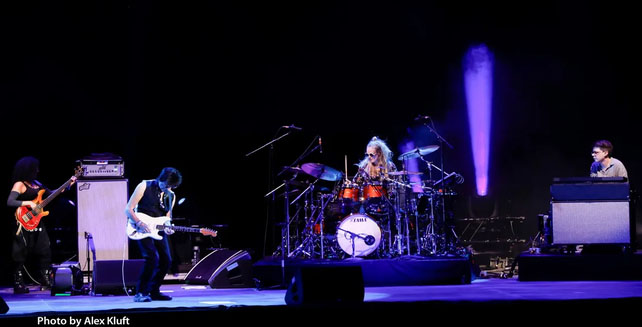
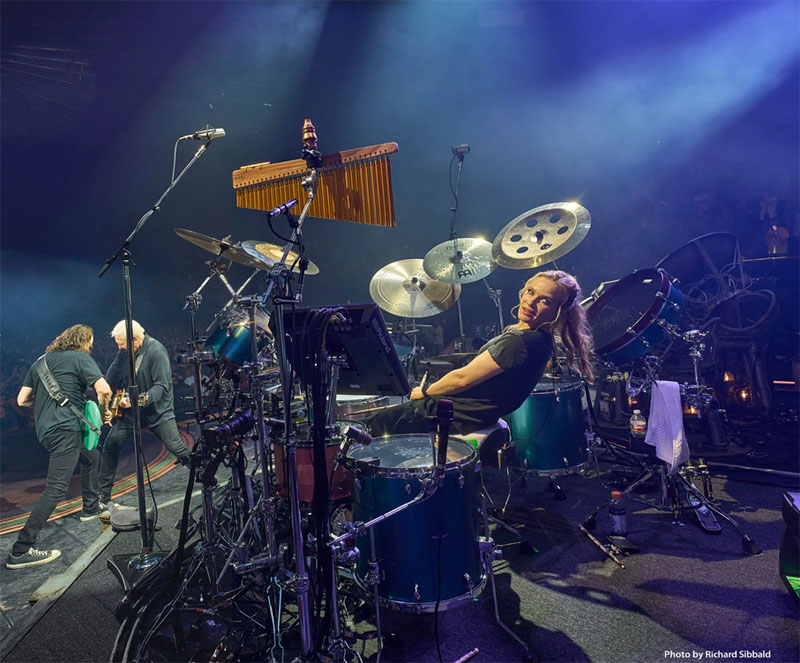
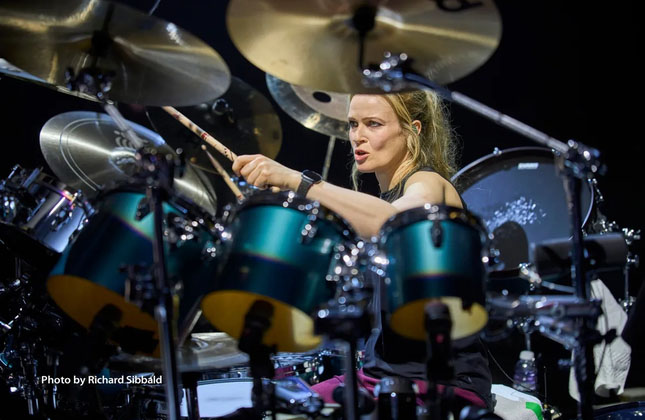
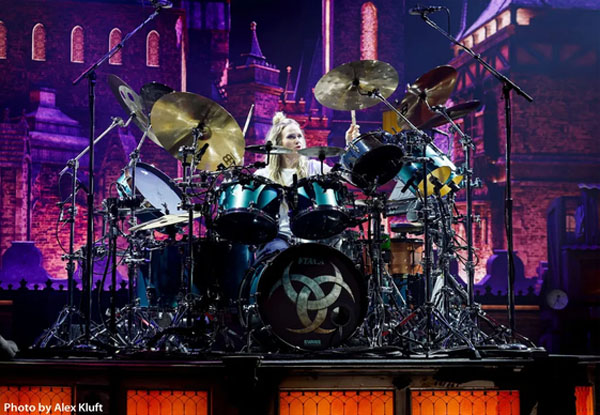
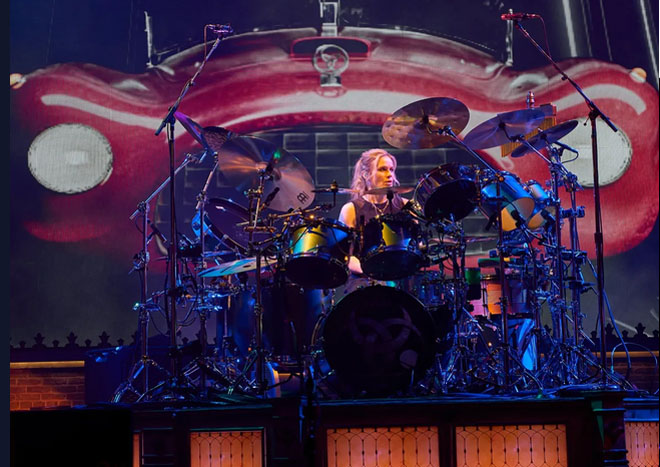
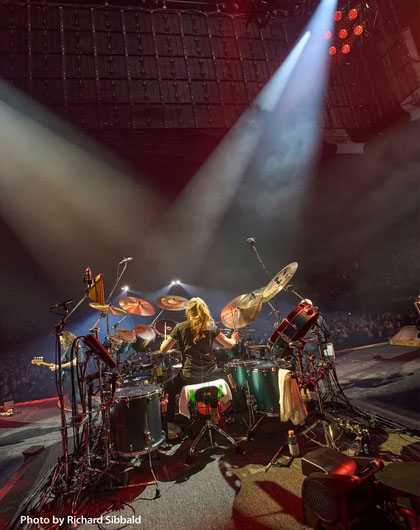
AN: On the road I don't really play on my off days. I try to relax my muscles and keep my body somehow relaxed. But on off days I work out in the gym because I want to do physical exercise rather than drum exercises. Everything has to be balanced to keep the ball rolling. This is a really tough show to play, even with good technique, you need to be in shape. This drum set is way bigger than my usual setup. The cymbals and the concert toms are super high. I always have my arms up high with this set; it's physical training by itself. So I work out in the gym, and at the venue I usually sit on my little electronic kit in the dressing room. That's also the time when I play through a couple of songs. I just play for myself, just getting muscles loose. Sometimes it's specific exercises, but not always. Sometimes I'll have an idea, and I write it down, but it's really different every day.
If you had that experience of reaching a goal because you worked at it, you know that you can reach every goal because you just have to put the work in.
MD: So you won't do the physical gym work on the show days because you're getting enough physical exertion playing the show. So you do the gym on off days and the drumming on show days. What's a go-to drum exercise that you've found to be helpful?
AN: Usually I just try to warm up my muscles. I try to do singles, doubles, and paradiddles, all in half strokes. And then I go up speed-wise to 200, 210, and so on. I try to keep them smooth. That really loosens up my muscles. That's my usual warm up. Then I sit on the kit and just play around. I put music on and just play along to some songs I like.
MD: I don't remember you playing a double pedal when I watched videos of yours in the past. But for this gig, obviously double bass is a big part of Neil's playing. Were you playing double pedal before Rush?
AN: A little with Jeff Beck.
MD: Just a little? So what did you do to get up to speed and be able to play like you are now? Everybody was waiting for the "Vital Signs" outro when the big double bass kicks in. But there's all kinds of moments like that double bass wise. What did you do to develop that?
AN: I'm really not a big double bass player. Luckily, Neil didn't go too wild with his double pedal playing. He used it in the right places to really push a part of the song, but he didn't go wild like the metal guys. He didn't play crazy rhythmic patterns. So I thought, okay, this is something I can learn quickly. I just have to develop the muscle stamina in my left foot, coordination, and timing; which is difficult with the feet.
But I actually stumbled into it by accident. I wouldn't have been at this point with my double pedal playing if I hadn't fractured my right big toe before the Jeff Beck tour. I wasn't planning on playing with a double pedal on Jeff's tour, but then I fractured my right big toe three days before we started tour rehearsals. I thought, 'Well... I can't do the tour.' Then we talked and I decided to give it a try with my left foot on a double pedal. At the time I was not into double bass playing, or double pedal playing at all. But I tried it and somehow it worked.
MD: Talk about pressure.
AN: Yeah, that was pressure, especially because I was coming in after Vinnie Colaiuta.
MD: Yeah, we've all seen the Live at Ronnie Scott's video.
AN: It was kind of embarrassing for me not to be able to play the way I usually play, because of the broken toe, I just wasn't able to play that way. So that brought me into double pedal playing. Through that, my left foot was getting stronger, and I was able to do things with the left foot I wasn't previously able to do. After my toe healed, I began playing a double pedal and Jeff realized it at some point, and he brought in some new songs where I had to play double pedal. Since then I've been practicing double pedal a little more here and there, just to keep it going.
MD: So that's how it happened... that's amazing. So when Neil's double bass parts came up, you already had some of the muscles going. Did you have any specific exercises or books that you used to develop your double pedal playing?
AN: I took a lesson with Thomas Lang once. He's great at that stuff. He gave me some advice, which I now include in my routine when I practice double bass. I took a lesson with Claus on double pedal. He gave me some exercises of playing the same stuff simultaneously with my hands and feet. I also practiced playing singles with the feet and playing paradiddles and different groupings with my hands on top, just to help build some stamina with my feet.
MD: When you're practicing those things, or any of the hand exercises, are you always using a metronome?
AN: Not always, but most of the time.
MD: That was always one of Dom's pet peeves. He always wanted every bit of practicing to be with the metronome for accuracy. But if for no other reason, but to monitor how well you're playing at different tempos? The science of drumming, if you will.
AN: I do a lot of my practice routine with a click track. I have sections where I practice specifically on timing with click, and I have more improvisational practice routines that are maybe done with a click, and maybe not. It's all chopped up in sections.
The band needed to sound how they sound, and Geddy and Alex needed to feel comfortable.
MD: Is there a click in any of the Rush songs?
AN: Not really. There are some samples, and when they come in, some of them have a click coming with it, but for the rest of the time, there's no click. You have to keep good time, so that when the sample comes in, you are in sync with the click or the timing of the sample. The samples were in there as we rehearsed. The first time we rehearsed, I was surprised because the samples came out of the blue. You know, when you practice along to the record, it's the record, you don't know if something will come out as a sample in the end.
MD: It's predictable.
AN: Yeah. Then when you're playing live — is something played by Alex, or is it played by Geddy's feet, or is it a sample coming from somewhere? When we play "The Spirit of Radio" we have a sequence coming on in the chorus. The first time I heard it, I was thinking, 'What's that?' It popped out way more than in the record version. And before the sample comes in you are going up and down in tempo, slowing down, speeding things up, and then that sample comes in, that was really difficult.
MD: And that sample is the same every night because it's a playback sample.
AN: Yes.
MD: But everything around it is different.
AN: Everything around it is different every night. Meanwhile, I might have a feeling that we are too slow or too fast in the verse, so I just try to keep better time during the verse.
MD: Do you trigger that sample?
AN: No, the keyboard player is triggering that sample. Then I play along with it on the bells and kick drum.
MD: I was actually going to ask you about that part. But before I do, I just want to cover one more non-specific drum thing. For monitoring, are you using wedges or in-ears?
AN: We are all on in-ears.
MD: Are you using a Porter and Davies thumper on your drum stool?
AN: No.
MD: Don't you miss the real low end just using in-ears?
AN: No, I get a little of the bass power from an onstage side cabinet.
MD: We'll have to get into gear in a proper Modern Drummer Tour Kit Rundown where we're at the kit and we can get into all of the drum nerdery and every percussive detail. But I want to cover the musical drum parts and how the equipment that relates to that.
Let's go to electronics for a second. You mentioned "The Spirit of Radio." Back in the early days, Neil had an actual glockenspiel and later on he had a Mallet Kat. So what are you doing for electronics on the glock part on "The Spirit of Radio"? I see an SPD-SX stage left. Is that the only electronic drum component for you? Or are you using drum triggers?
AN: I also have the Roland trigger bars, those little one-shot bars.
MD: How many of those do you have?
AN: I have three, plus the SPD-SX, and I have a trigger pedal on my left side for the cowbell in "Witch Hunt," the tambourine in "Leave That Thing Alone," and a couple of other songs.
Not being tight all the time with your muscles, keeping relaxed while playing, that changes your sound too. That's a big game changer.
MD: You're playing all that with your left foot? Very cool. And for all the sounds in the SPD-SX, you worked with the team and got all the samples and figured out how you were going to play what.
AN: Yeah, actually the production team sampled Neil's percussion sounds at some point, because Neil also had the Mallet Kat thing. That way he didn't have to use all the proper percussion instruments.
MD: Right, for "Closer to the Heart" he used to have the big chimes and the tubular bells behind him, and eventually he went to electronics.
AN: Yes, exactly.
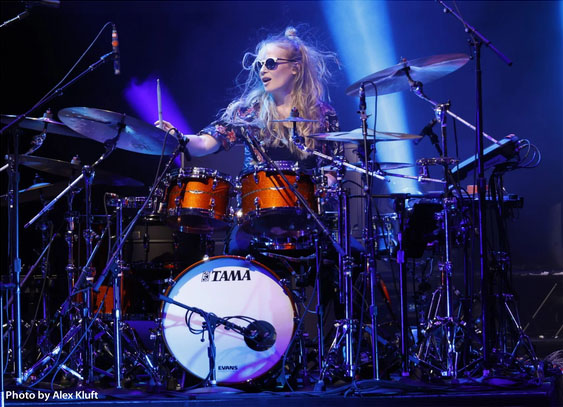
MD: So all of that is now in the SPD-SX.
AN: Yes.
MD: That's so great. I just had a drum dream moment. As a drummer, just thinking about triggering those sounds as you're playing "Closer to the Heart." That's such a profound song to be playing in this tribute. I remember in the old days of seeing the band, the crowd would sing along to all of that, but Neil's back would be to the crowd because he was playing the actual big bell chimes. Last night, just seeing you playing that part was just awesome and beautiful.
AN: Thank you. I have to say that Lorne, Neil's drum tech...
MD: "Gump..."
AN: "Gump," exactly, was a huge help in preparing all those sounds because Neil was not there. No one really knew when he was triggering what sound, because there were some sounds from the electronic era, when he had a lot of electronics involved. That's when he had all these little triggers and Roland pads everywhere. But no one really knew what sample was on what pad, and all the practical details.
MD: Because he did a lot of it himself.
AN: Yeah.
I paint with acrylics at home, that's a bit of my hobby. A drum head is a simple canvas to me... so we ended up with two of my designs on my rack tom heads.
MD: A lot of times there's a tech, and they (kind of) do it all and the drummer just plays it. But Neil was (kind of) a one man show in that regard.
AK: And you must place the sounds around the kit in a way that you can reach them and include them in your playing. So I was asking, 'Where is this sound happening and how do I include that sound on the set?' Lorne was able to remember parts of it, but we have different electronics today because the electronic world keeps developing.
MD: Yeah, R40 was in 2015, and every year there's new electronic equipment being released.
AN: Exactly. So we had many different options. And I placed everything a little differently to accommodate my way of playing. But all the sounds are there.
MD: Yes, they all are there. If I'm remembering correctly, on "Vital Signs" there's two different snare sounds. There's the regular snare and then there's a very tight, almost marching electronic, popcorn sounding snare. Do you have a side snare on stage left?
AN: I have a timbale snare to the side. There are snares on it, but I actually use it as a timbale. It sounds thinner than a regular snare but it's punchier and cuts through.
MD: What do you use that on?
AN: That's on "Headlong Flight," "The Trees," and maybe "Caravan," I'm not sure right now.
MD: Are you using any acoustic drum triggers to trigger different sounds? You're not hitting a snare, a bass drum, or a tom to trigger a sound?
AN: No.
MD: The acoustics are acoustic and the electronics are separate?
AN: We tried. I told them I would love to try it, but it didn't really work with those big toms. But I do have a little trigger bar between my hi-hat and the snare. You can barely see it. It's really in a tight spot. But that is where that snare sound comes from.
MD: I thought you were playing the left snare. So that little trigger bar is the answer to my snare question.
AN: Yeah.
MD: In "New World Man" it seemed like you were playing the right hand hi-hats and the ride in that particular song. I don't remember Neil having a right hi-hat, he had a closed hat somewhere else, but did you figure out that was how you wanted to play it? Because sonically and musically, it sounded perfect, but I noticed that was different.
AN: Yeah, that's true. I'm hitting both with the right, it's a halftime beat.
MD: Did you just think that you got more power by doing it open handed.
AN: I don't know. I didn't think about it that much. That's just what I heard, so I figured I'd play it that way.
MD: The ride cymbal and the hi-hat sound on Neil's recordings, especially in the late seventies and early eighties, when he was with Zildjian (and that's not a comment about Zildjian or Sabian, it's just what happened) are iconic. When you listen to when the ride pattern opens up in "The Spirit of Radio," that ride cymbal sound is perfect. There are all kinds of different iconic cymbal sound moments, but Neil had a certain definition to his ride cymbal, especially with those older Zildjians, and he captured it when he did his Sabian Paragon series. But the "The Spirit of Radio" ride and the "Red Barchetta" hi-hats — those sounds are so embedded in the music that you can't separate the sound of those cymbals from the music.
AN: That's true.
It really clicked for me in a way that I knew if I just work hard and really practice, then I can reach everything, all my goals.
MD: What really surprised me, in a positive way, because I had never heard a cymbal sound like that (of Neil's in the early 80's), was that the ride and hi-hat sounds you are playing fit the songs perfectly. When you went to "The Spirit of Radio," I thought, wow, I'm hearing the Zildjian Ping Ride that Neil had. Yours didn't sound different. It has to cut, but if it's too metallic or too washy, it doesn't sound right. So what are you using? What did you do to nail it?
AN: We actually worked on that specific topic. When I came to the first rehearsal, I didn't come with my regular setup. I was already using more brilliant cymbals for the rehearsals because I thought that would be the way to go. But the hi-hat didn't seem right. It felt too washy, and not clear enough, there was no chick. With the ride I had with me, Geddy said he couldn't hear anything when I played it. The whole song didn't sound right. You know what one cymbal can do...
MD: It's huge, especially with this band. Absolutely. Neil was that particular. But I love hearing the process you went through.
AN: I was definitely looking for cymbals in all the different series Meinl has, that were closer to the sound I heard on the recordings and live. It wasn't a completely different sound. I learned songs from so many eras and different recording situations, and maybe I was even different cymbals. But I knew that I was looking for something that was more the sound of his earlier drum sound especially from the toms. But cymbal-wise, I really like his 80s cymbal sound.
...there were also moments on day four when I thought, 'I'm not sure if I'm up to this task.' Because we talked about the feeling with "Tom Sawyer" on day four and I had to learn about Neil's feeling really quick.
MD: Those are some of the best cymbal sounds ever.
AN: I wanted a really clear definition from the ride cymbal, and a really clear definition from the hi-hats. So I described what I needed, and what Geddy and Alex needed to hear to the Meinl guys. That's where we started. Neil's hi-hat and ride cymbal (and the snare too) created a lot of feelings for Geddy and Alex. That was a good reason for Meinl to develop a version of Neil's sound. All along I was taking different cymbals and different versions with me to rehearsals just to see how they worked.
MD: So they were sending you cymbals?
AN: Yes. At first, the cymbals were still a bit too washy. So I sent them back and explained what the issue was. Then I kept getting new versions. At some point, I didn't get any more feedback from Geddy and Alex. That was good, it felt really natural.
MD: What Meinl ride cymbal did you wind up using? Do you have a signature cymbal?
AN: Yeah. For now, it's a limited version. It's a 22, and it's called the Lunar Ride.
MD: And what are the hi-hats?
AN: 14's.
MD: And those are a product of all of that back and forth?
AN: Yes.
MD: Did they have to send you prototypes really fast?
AN: Yeah. They were prioritizing me. But they are always really quick. I mean, they have the whole production in Germany. So when I was back home, I was always going back just between my home and the factory.
MD: From the time you started, how long did it take them to finally get to the Lunar Ride?
AN: Maybe two and a half or three months.
MD: Considering that's the development of a cymbal virtually from scratch, that's very fast. And that's the cymbal I'm hearing live?
AN: Yeah.
MD: Well, I have to congratulate you and Meinl on nailing it. Because I was pleasantly surprised, and really happy to hear that sound. Regardless of what cymbal manufacturer, I was just wondering how you were going to get that sound, and what was it going to sound like?
Anika: Yeah.
MD: What snare are you using? Because that is another signature of Neil and Rush's sound.
AN: That's true. But I cannot talk too much about my snare because it's a signature snare that will be released very soon, but I cannot talk about anything about the snare... yet. Tama and I have been developing that snare over the last three years. That development started even before Rush.
MD: Everything sounded great, but I wanted to ask you about the look of your drumheads. It looks like you have some graphics on your tom heads.
AN: Those are actually some prints that I have on the drumheads. The great folks from Evans, have a new option to put a print on their heads. When I saw that, I immediately jumped on it, because I usually paint my drumheads. I love to do that.
MD: Really? On the batter heads?
AN: Yes, I love to paint.
MD: You would paint on them yourself?
AN: Yes, I would paint with proper ink on my heads.
MD: Do you have art that you've painted aside of your drumheads?
AN: I do. I paint with acrylics at home, that's a bit of my hobby. A drum head is a simple canvas to me. So when they told me that they had this new option, and they asked me if I ever wanted to do something — I said, 'Let's do it!' And I immediately started designing some stuff. I checked back with the Geddy and Alex, just to be sure they were fine with it, and they loved it. And so we ended up with two of my designs on my rack tom heads.
MD: What model heads are they?
AN: Evans, the painted heads are Black Chrome, and all my other heads are Black Chrome too.
MD: And are those available commercially? Can people buy them?
AN: They will be able to, they're coming soon.
Have faith in yourself, believe in yourself and you can reach everything. It's not just a saying, it's the truth.
MD: Have you noticed a difference in the sound? I know you generally like deader sounding drums, so the paint probably creates more muffling, which is probably good for your sound, but have you noticed a difference?
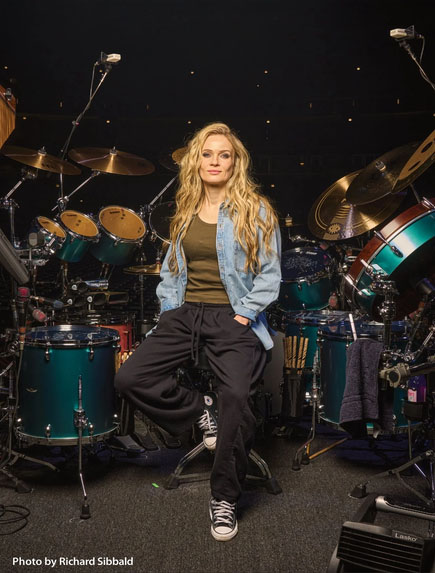
AN: It is a slightly bit more dampened, yes. It's even less than what you would hear if you put a small damper tube on a drum.
MD: So what's next? Here we are on the Rush tour. I know there are dates into 2027. Are you looking beyond that right now, what's the future look like?
AN: Right now it's just enjoying what we are doing, but in the background my team is booking shows for my band. The first gig after Rush is with my band and a big orchestra.
MD: Are those dates in between Rush touring legs?
AN: No, it's when Rush is finished. I don't want to do anything in between Rush legs. But after we finish, I will start off with my band playing shows again, and a new album maybe.
MD: Between the signature products, your own band Nevell, and Rush. If there was ever a time that I could say that somebody was living the dream, this feels like that time.
AN: Definitely!
MD: And that's what happens when practice meets perseverance, meets faith, meets timing. Thank you for taking the time with us today. Thank you for all that you're doing with Rush, for the Rush fans, and for the drum community. You're really paying tribute to Neil in the most beautiful way. Actually in a way that I couldn't even imagine, until it actually happened. I know I speak on behalf of millions of people when I say thank you. We love the band, we love their music, we love your drumming, and we love the way you are drumming inside of Rush and paying tribute to "The Professor" Neil Peart. You (and the band) are bringing the music back in such a perfect way.
The thing that hit me last night at the show was, 'Wait a second, I thought R40 was the last time I was ever going to hear this band performed live, but here it is again, and it's amazing! Sometimes you see bands do tributes, reunions, or you see a band come back after they've said we're going to stop, and it's kind of a letdown. This is NOT that! This is wow! Thank God they're back! This is so great! The music feels fresh and alive. And it's so great to see Neil honored, because now all the generations of new fans can hear what those parts sound like live in a concert hall. This is only the second of what I'm sure will be many Anika Nilles Modern Drummer covers. Congratulations, Anika. Geddy and Alex, we love you!
AN: Thank you.